Title 21 of the Code of Federal Regulations (CFR), section 7.3(g), describes a recall as a firm’s removal or correction of a marketed product that FDA judges to be in violation of the laws we administer and against which the FDA would start legal action, such as seizure.
FDA strongly advises businesses to familiarise themselves with all of the regulations, including the elements of a recall strategy, in 21 CFR Part 7.
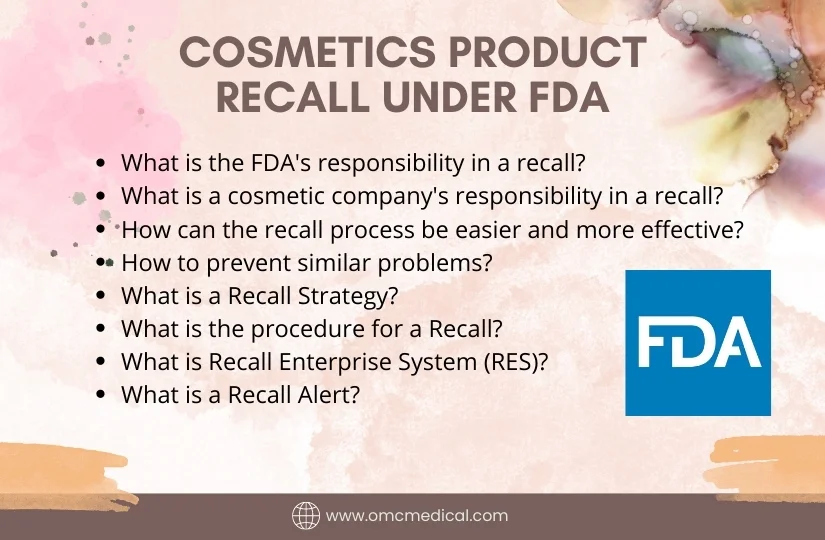
What is the FDA’s responsibility in a recall of Cosmetics Product?
The FD&C Act does not give FDA the authority to mandate the recall of a cosmetic product, but it does give FDA the authority to request a company to do so. They do, however, actively participate in recalls.
- The FDA keep track of recall developments. They may perform their own audit inspections at wholesale or retail customers in addition to examining company status reports to ensure the recall’s efficacy.
- The FDA determines the level of the health risk posed by a product under recall and assigns a classification to represent that risk:
- The FDA or the company may issue a public notification if it determines that it is necessary. The FDA will publish a press statement if the company declines or unreasonably postpones doing so. The FDA Enforcement Report, a weekly publication that includes details on all recalls for which classification has been assigned, is another way that FDA disseminates broad information on recalls.
- If FDA requests a recall, they create a suggested plan for each recall that specifies how the Agency wants it to be executed and whether a press statement is required. The FDA will analyse and offer comments on the firm’s recall strategy if one is developed.
- The FDA guarantees that the product is either destroyed or properly refurbished.
What is a cosmetics product company’s responsibility in a recall?
The following is what the company is required to do in accordance with 21 CFR Part 7:
Ready to Streamline Your Regulatory Compliance?
Join hundreds of companies who trust OMC Medical for their regulatory needs. Get expert guidance and ensure compliance across all markets.
Call Now +44 208 066 7260- Customers should be notified by the company. According to 21 CFR 7.49, the notification’s format, content, and scope should be appropriate for the risk the product poses and the recall plan that was created for it.
- When a recall is announced, the company must inform the relevant FDA district office.
- Periodic recall status updates should be sent by the company to the relevant FDA district office so that the FDA can monitor the recall’s development.
- If the company or FDA decides that a public warning is essential, they should submit a statement to that effect along with a distribution strategy for FDA’s assessment and feedback.
- The business must carry out effectiveness checks in accordance with 21 CFR 7.42(b) (3).
- Whether the recalled product is destroyed or brought into compliance, the corporation oversees how it is handled.
How can the recall process be easier and more effective?
The simplest method to reduce the workload associated with product recalls is to thoroughly avoid product adulteration and misbranding in the first place. However, by being ready in advance, businesses can reduce the damage in the event that a recall is required.
- Keep a backup plan in place in case a recall needs to be started in accordance with the recall rules.
- Give numbers to production lots or batches. Law does not mandate lot numbers for cosmetics product. But it enables you to decide if some or all cosmetics products lots need to be recalled. Since it will probably be impossible to pinpoint the exact production runs implicated if the items don’t have lot numbers, it might be required to recall every cosmetics product currently on the market.
- Keep proper distribution data to make it easier to find recalled cosmetics products. Keep them around for longer than the product’s expected shelf life and utilise.
How to prevent similar problems?
The corporation should take the kind of remedial efforts that stop a similar issue from happening in the future, in addition to the corrective actions of withdrawing a violative product from the market and either destroying it or bringing it into compliance.
- Identify the cause of the violation,
- Decide what adjustments need to be made to prevent the issue from occurring again
- Execute such modifications
When conducting an inspection in connection with a recall, an FDA inspector may check for these factors.